What Are Smart Links for Musicians? The Complete 2026 Guide
Introduction — The One Link Problem Every Musician Faces
There’s a moment every musician knows, even if they’ve never named it.
The song is out.
The video is live.
A clip starts moving through TikTok, Instagram, or YouTube, picking up quiet momentum.
Notifications flicker. A few DMs roll in. Someone asks, “Where can I hear more?”
And then comes the decision that feels small — almost automatic — but quietly determines whether that moment grows or disappears:
Where do you send them?
For years, musicians were told the answer was simple. Put one link in your bio. Funnel everything — every discovery, every fan, every spark of curiosity — into a single static page and move on.
That advice used to work.
It doesn’t anymore.
In 2026, music discovery is fragmented by design. Fans don’t arrive through a single doorway. Some find you through a 15-second TikTok clip. Others hear you through a YouTube recommendation late at night. Some scan a QR code on a poster outside a venue. Others search your name days or weeks after a show because a lyric stayed with them.
Each of those fans arrives with a different level of intent.
Some want to hear one song and decide in seconds if it’s worth saving.
Some want to watch a video before they commit.
Some want tickets.
Some want to follow you before the moment passes.
Yet most musicians still send all of them to the exact same destination.
That’s where momentum breaks.
Not because the music isn’t good — but because the experience ignores why the fan showed up. A static link treats every listener the same, no matter how they found you or what they’re ready for next. The result is friction, hesitation, and quiet drop-off — moments that feel like interest but never turn into connection.
This is the hidden cost of the “one link” approach: lost context.
Smart links were created to fix that.
Not as a prettier link-in-bio page.
Not as another tool to manage.
But as a way to meet fans where they are — with the right content, at the right time, through a path that actually makes sense.
Before defining what smart links are, it’s important to understand why static links fail — and why a modern music career needs something more adaptive.
Table of Contents
- Introduction — The One Link Problem Every Musician Faces
- What Is a Smart Link? Simple Definition
- What Makes a Smart Link Different for Musicians
- Why Smart Links Matter in 2026
- Smart Links vs Link in Bio Tools
- The Fan Journey From Discovery to Deep Engagement
- How Smart Links Actually Work
- What Makes a Smart Link Convert Fans
- The Anatomy of a High Converting Smart Link Page
- Smart Links for Different Types of Musicians
- Smart Links QR Codes and Offline Fans
- Smart Link Analytics Understanding Fan Behavior
- Common Smart Link Mistakes Musicians Make
- How to Build a Smart Link That Grows With Your Career
- The Future of Smart Links for Musicians
- Are Smart Links Worth It in 2026
- Frequently Asked Questions About Smart Links for Musicians
What Is a Smart Link? Simple Definition
A smart link is a single link that adapts to the fan instead of forcing every fan through the same static path.
At its most basic level, a smart link is a central hub for your music, content, and actions — but unlike a traditional link or link-in-bio page, it is designed to respond to context.
Context like:
- How the fan discovered you
- What device they’re on
- What they’re most likely trying to do next
Instead of acting as a dead-end directory, a smart link acts like a guided entry point into your music world.
When someone clicks a smart link, they’re not just shown a list of buttons. They’re presented with an experience that prioritizes what matters right now — whether that’s listening to a song, watching a video, buying tickets, or following you before the moment fades.
This is the key difference.
A normal link says, “Here’s everything. Figure it out.”
A smart link says, “Here’s what makes sense next.”
For musicians, that distinction is critical. Music discovery is emotional and time-sensitive. Fans decide in seconds whether to lean in or move on. A smart link removes unnecessary choices and surfaces the most relevant action first.
Importantly, a smart link doesn’t replace your website, your streaming platforms, or your social profiles. It connects them — intelligently — into a single entry point that works across platforms, campaigns, and real-world touchpoints.
In short, a smart link is not just a link.
It’s a decision layer between discovery and engagement — designed to turn fleeting interest into something that lasts.
What Makes a Smart Link Different for Musicians
Smart links exist in many industries, but musicians need something fundamentally different from influencers, creators, or traditional businesses.
Music discovery is not transactional.
It’s emotional, impulsive, and fragile.
A fan doesn’t arrive thinking, “I’d like to evaluate this artist.”
They arrive thinking, “This feels like something.”
What happens in the next few seconds determines whether that feeling turns into a save, a follow, a ticket sale — or disappears entirely.
This is where generic smart links fall short, and musician-focused smart links matter.
Musicians don’t just need a place to send traffic. They need a way to preserve momentum and turn fleeting attention into something deeper. That’s why smart links designed for musicians focus less on options and more on connection — helping artists build the kind of long-term relationships that lead to real fan loyalty, not just clicks.
If you’ve ever wondered why some artists seem to turn casual listeners into genuine supporters while others struggle, it often comes down to how that first moment is handled. Smart links built for musicians are designed to support that transition into real fan connections, not interrupt it with friction or confusion.
A musician-ready smart link is built around three realities that most tools ignore.
First, music is experienced before it’s understood.
Fans don’t want to read. They want to listen or watch. Smart links for musicians prioritize embedded audio and video immediately, allowing the music itself to do the work before anything else competes for attention.
Second, fans arrive at different stages of intent.
Some are discovering you for the first time. Others already care and want more — another song, a video, a tour date. Musician-focused smart links guide fans forward naturally instead of overwhelming them with choices that don’t match their readiness.
Third, musicians don’t control discovery platforms — but they can control what happens next.
Algorithms decide who sees a clip. Playlists decide exposure. Social feeds decide reach. A smart link gives musicians ownership over the moment after discovery, where real engagement and memory are formed.
This is why a musician’s smart link isn’t just a list of destinations.
It’s a bridge between:
- a song and a fan
- a moment and a memory
- attention and action
When designed correctly, a smart link doesn’t feel like a tool at all. It feels like a continuation of the music — a place where the energy of discovery doesn’t drop off, but deepens.
That distinction is what separates smart links built for musicians from everything else that only looks similar on the surface.
That’s why smart links designed for musicians focus less on options and more on helping artists build real fan connections that last, instead of interrupting momentum with friction or confusion.
Why Smart Links Matter in 2026
Smart links didn’t become important because musicians wanted another tool.
They became important because the way fans discover and engage with music changed — and never went back.
In 2026, discovery rarely happens in a straight line. A fan might hear a song in a short-form clip, forget about it, stumble across it again on a streaming platform days later, and finally take action after a live show or a late-night search.
This isn’t unusual anymore.
It’s how music is found now.
In the streaming age, musicians aren’t just competing for attention — they’re competing for continuity. Exposure alone doesn’t build careers. What matters is whether a listener comes back, follows, saves, or remembers you at all. This shift is explored in detail in Smart Links in the Streaming Age: Convert Casual Listeners into Lifelong Fans, where real fan behavior shows why post-discovery experience matters more than ever.
Streaming platforms decide what gets surfaced. Social algorithms decide what gets seen. Context disappears quickly. What hasn’t changed is how fans connect to music emotionally — they still feel something, but the window to guide that feeling is short.
Smart links matter in 2026 because they give musicians control over that window.
Artists can’t control algorithms, playlists, or feeds. But they can control what happens when a fan clicks. Smart links shape that moment, guiding listeners forward instead of dropping them onto static pages that treat every visitor the same.
There’s also a practical reality most musicians are already living.
You’re not promoting one thing at a time anymore. Singles overlap with videos. Tours overlap with releases. Merch lives alongside social content. A static link flattens all of that into a list, forcing fans to decide what matters without any guidance.
Smart links adapt.
They let artists highlight what matters right now — a new release, a tour announcement, a featured video — while still giving curious fans a path to explore deeper when they’re ready.
Most importantly, smart links reflect a deeper shift in how musicians grow.
Success in 2026 isn’t defined by reach alone. It’s defined by momentum — by whether interest compounds or fades. Smart links sit at the center of that process, quietly shaping fan journeys while revealing what static links never can.
That’s why smart links matter now — not as a trend, but as essential infrastructure for a modern music career.
Smart Links vs Link in Bio Tools
At first glance, smart links and link-in-bio tools can look similar.
They both promise one destination for your music.
They both live behind a single URL.
They both claim to simplify promotion.
But beneath the surface, they solve very different problems.
Link-in-bio tools were designed for organization. Their job is to collect links in one place and let the fan decide what to do next. For influencers and brands, that’s often enough. The goal is visibility, not depth.
For musicians, that approach breaks down quickly.
Music discovery is emotional and time-sensitive. Fans don’t arrive ready to browse. They arrive in a moment — curious, distracted, and deciding whether to lean in or move on. A typical link-in-bio page presents a flat list of options with no guidance, no prioritization, and no understanding of why the fan clicked in the first place.
That’s where smart links differ fundamentally.
Smart links are built around intent, not just destinations. Instead of asking fans to figure things out on their own, smart links guide them toward the most meaningful next step — whether that’s hearing a song, watching a video, saving a release, or following you while the moment is still warm.
This distinction becomes especially clear when you compare smart links and link-in-bio tools side by side. As explained in Smart Links vs. Link-in-Bio Tools: What Musicians Really Need, the difference isn’t about features — it’s about behavior. One organizes links. The other shapes fan journeys.
Another key difference is adaptability.
A link-in-bio page treats every visit the same. A smart link can evolve with your career, your releases, and your campaigns. What you emphasize today doesn’t have to be what you emphasize next month. The link stays the same, but the experience adapts.
That flexibility matters in a world where musicians are rarely promoting just one thing at a time. Singles overlap with videos. Tours overlap with releases. Static pages struggle to keep up.
In practice, the choice isn’t between “one link or many links.”
It’s between a passive directory and an active bridge.
Link-in-bio tools list where you are.
Smart links help fans decide where to go next.
For musicians trying to turn discovery into momentum, that difference is everything.
The Fan Journey From Discovery to Deep Engagement
Most musicians think in terms of promotion.
Fans experience something very different.
From a fan’s perspective, discovery rarely feels like a funnel. It feels like a series of moments — scattered, emotional, and often unplanned. A clip on TikTok. A song playing in the background of a Story. A QR code on a poster outside a venue. A friend sending a link late at night.
Each moment creates a small opening.
What happens next determines whether that opening closes or turns into something lasting.
This is why understanding the fan journey matters more than optimizing individual links. Fans don’t want to be routed. They want to be guided. They want the next step to feel obvious, effortless, and aligned with why they clicked in the first place.
A well-designed smart link supports this journey by adapting to context.
A first-time listener might arrive needing proof — a song, a video, a reason to care. A returning fan might be looking for depth — more music, a live date, a way to stay connected. Someone scanning a QR code after a show might want something immediate — a follow, a save, a reminder not to forget you tomorrow.
Smart links make space for all of these paths without forcing them into the same experience.
This idea of a guided journey — rather than a static destination — is explored further in Music Links for Artists: Build a Seamless Fan Journey Across Platforms, where the focus shifts from individual clicks to how fans move across touchpoints over time.
What makes this powerful is subtlety.
Fans don’t feel like they’re being pushed down a funnel. They feel like they’re being met where they are. The music comes first. The next action feels natural. Nothing competes for attention that shouldn’t.
Over time, these small moments compound.
A casual listener becomes a follower.
A follower becomes a repeat listener.
A repeat listener becomes someone who shows up — online, at shows, and eventually in real life.
This is what smart links are uniquely positioned to support: not just traffic, but continuity.
They don’t just answer the question “Where should this link go?”
They answer the more important one: “What should happen next?”
How Smart Links Actually Work
From the outside, a smart link looks simple — one URL, one destination.
Underneath, there’s more intention at work.
A smart link functions as a centralized hub that connects your music, media, and actions into a single entry point, while still allowing different fans to experience different paths. Instead of acting like a static list, it acts more like a traffic controller — quietly deciding what should be emphasized based on context and timing.
At a basic level, smart links bring everything together:
- Streaming platforms
- Videos
- Live dates
- Social profiles
- Merch or mailing lists
But what makes them “smart” isn’t aggregation. It’s prioritization.
A smart link is designed so that not everything competes at once. The most important action — listening to a new release, watching a featured video, saving a song, or following you — is surfaced clearly, while secondary options remain accessible without overwhelming the fan.
This centralized approach is what allows smart links to work across so many different scenarios. Whether someone clicks from a TikTok bio, a YouTube description, or a QR code on a poster, the link remains the same — but the experience can be shaped to match the moment.
This idea of using a smart link as a central hub for your music and promotion is explored more deeply in The Smart Link Revolution: Why Every Artist Needs a Centralized Hub, where the focus shifts from individual campaigns to long-term infrastructure.
Another important detail is what smart links don’t do.
They don’t replace your website.
They don’t replace streaming platforms.
They don’t try to own your audience.
Instead, they connect the places where your music already lives and give fans a smoother way to move between them. The smart link becomes the starting point — not the destination.
This is why smart links scale so well as careers grow.
As releases change, tours start and end, and new content comes into focus, the same link continues to work. You update the experience behind it, not the URL itself. Fans never have to relearn where to go.
In practice, that’s what makes smart links powerful.
They remove friction, reduce confusion, and quietly support momentum — without asking fans to think about how the system works at all.
What Makes a Smart Link Convert Fans
Clicks don’t build music careers.
Conversions do.
A fan converting doesn’t always mean a sale. More often, it means a small but meaningful action: saving a song, following an artist, watching a video all the way through, or coming back tomorrow instead of forgetting you entirely.
Smart links convert fans because they are designed around human behavior, not just traffic.
The first principle is focus.
When a fan arrives, they should immediately understand what matters most right now. A high-converting smart link doesn’t present ten equal choices. It highlights one primary action and supports it with context. This reduces hesitation and keeps the emotional momentum intact.
The second principle is familiarity.
Fans are far more likely to engage when the experience feels natural. Embedded audio and video matter because they remove friction. A fan doesn’t have to leave, load another app, or reorient themselves. The music is right there, ready to play, which dramatically increases follow-through.
The third principle is timing.
A first-time listener and a returning fan shouldn’t be treated the same. Someone discovering you for the first time may need proof — a song, a video, a reason to trust their curiosity. Someone who already cares may be looking for depth — tour dates, merch, or a way to stay connected. Smart links convert because they respect these differences instead of flattening every visit into the same experience.
This behavioral approach is why smart links consistently outperform traditional link-in-bio pages. The psychology behind this difference is explored in detail in The Psychology of Fan Conversion: Why Smart Links Outperform Link-in-Bio Tools Every Time, where fan decision-making patterns explain why guidance beats choice overload.
Another often-overlooked factor is trust.
A smart link that feels intentional signals professionalism. Clean layout, clear hierarchy, and media-first design reassure fans that they’re in the right place. That confidence makes the next action easier.
Over time, these elements compound.
A fan who converts once is more likely to convert again.
A fan who feels guided is more likely to stay.
A fan who stays is more likely to support you when it matters.
This is what smart links do best.
They don’t force conversion.
They enable it — by aligning timing, intent, and emotion into a single, seamless experience.
The Anatomy of a High Converting Smart Link Page
A smart link only works as well as the page behind it.
Conversion doesn’t happen because a page exists — it happens because every element on that page earns its place. High-converting smart link pages aren’t busy. They’re intentional.
The first element is immediate context.
When a fan lands on a smart link page, they should instantly understand who they’re looking at and why they’re there. Artist name, visual identity, and a clear sense of mood matter more than clever copy. This isn’t about branding polish — it’s about orientation. Fans decide in seconds whether they’re in the right place.
Next comes media-first hierarchy.
Music must lead. A high-converting smart link page puts audio or video at the center of the experience, not behind buttons or below long lists. The music does the convincing before anything else asks for attention. When fans can press play immediately, hesitation disappears.
After that comes guided choice.
Instead of presenting every possible destination at once, strong smart link pages guide fans through a clear path:
- Listen or watch first
- Follow or save next
- Explore deeper only if they want to
This hierarchy prevents overload while still supporting curiosity. Fans never feel trapped, but they also never feel lost.
Another critical element is visual flow.
Spacing, contrast, and layout all influence how long a fan stays and what they do next. High-converting pages feel breathable. Nothing competes unnecessarily. Each section leads naturally into the next, reinforcing momentum instead of interrupting it.
These principles are broken down in detail in The Anatomy of a Perfect Smart Link Page for Musicians, where layout decisions are tied directly to fan behavior and conversion outcomes.
Finally, there’s adaptability.
A smart link page shouldn’t be frozen in time. As releases change, tours come and go, and priorities shift, the page should evolve without forcing you to change the link itself. High-converting smart link pages are built to grow alongside the artist — staying relevant without retraining fans.
When all of these elements work together, the result feels effortless.
Fans don’t think about why the page works.
They just move forward.
That’s the anatomy of a smart link page that doesn’t just collect clicks — it converts attention into momentum.
Smart Links for Different Types of Musicians
Not every musician needs the same smart link experience.
A solo artist releasing their first single, a touring band selling tickets, and a manager overseeing multiple projects all face different priorities. High-performing smart links account for these differences instead of forcing everyone into the same structure.
The value of a smart link isn’t just that it exists — it’s that it can be shaped to match who you are and what you’re trying to accomplish right now.
Independent Artists
For independent artists, the smart link is often the first real home base.
Many indie artists don’t have a full website, and even when they do, fans rarely land there first. Discovery usually happens on social platforms or streaming services, which makes the smart link the primary moment of decision.
A high-performing smart link for an indie artist focuses on:
- One or two standout songs or videos
- A clear follow or save action
- Minimal distractions
The goal isn’t to explain everything. It’s to give new listeners a fast, confident way to say, “Yes — I want more.” This approach is explored in depth in Why Every Indie Artist Needs a Smart Link Strategy, where early-stage growth depends heavily on reducing friction at the moment of discovery.
Bands
Bands face a different challenge: multiple entry points.
Fans might discover a band through a live show, a shared clip, a playlist add, or a recommendation from another fan. Band-focused smart links often need to balance media, touring information, and identity all at once — without becoming cluttered.
Effective smart links for bands typically:
- Lead with music or live video
- Clearly surface upcoming shows
- Reinforce the band’s identity visually
This balance is critical for converting interest into attendance and long-term support. It’s covered more deeply in The Ultimate Guide to Smart Links for Bands, which breaks down how bands can use smart links across tours, releases, and promotions.
Managers and Labels
For managers and labels, smart links become tools for clarity and consistency.
Instead of sending fans, partners, or industry contacts to scattered destinations, a smart link creates a controlled entry point that reflects the current focus — a release, a campaign, or an artist spotlight. This keeps messaging aligned without constant updates across platforms.
In these cases, the smart link functions less as a promotional page and more as a coordination layer.
Touring Artists
Touring artists operate in moments.
A smart link scanned from a poster, merch table, or stage backdrop needs to work instantly. Fans are often on their phones, distracted, and deciding whether to act before the moment fades.
For touring musicians, smart links perform best when they:
- Prioritize follow or save actions
- Highlight upcoming dates
- Reduce scrolling and decision-making
Here, simplicity isn’t a limitation — it’s the advantage.
Across all of these cases, the principle is the same.
Smart links work best when they’re shaped around the artist’s context, not forced into a one-size-fits-all template. When the structure matches the situation, fans don’t have to think — they just move forward.
Smart Links QR Codes and Offline Fans
Not all discovery happens on screens.
Some of the most valuable fan moments happen offline — at shows, on the street, at festivals, or in places where attention is brief and memory fades fast. A poster on a wall. A flyer handed out after a set. A sticker on a guitar case. A QR code on merch.
This is where smart links quietly outperform everything else.
QR codes turn offline curiosity into an immediate digital action, but only if the experience behind the scan makes sense. A basic link-in-bio page often fails here. It presents too many choices to fans who are distracted, tired, or on the move.
Smart links are built for these moments.
When a fan scans a QR code, they’re usually looking for one of three things:
- A quick way to remember you
- A song they just heard
- A reason to follow before the moment passes
A smart link connected to a QR code can prioritize exactly that — a featured track, a follow button, or a short video that reinforces the live experience they just had. Nothing extra competes for attention.
This offline-to-online bridge is one of the biggest reasons musicians are moving away from generic bio links. As explained in The Best Linktree Alternative for Musicians: QR Codes, Music Embeds & Fan Analytics, QR-powered smart links work because they respect context instead of ignoring it.
The physical world creates urgency.
A fan standing outside a venue doesn’t want to scroll.
A fan scanning merch doesn’t want to decide.
A fan seeing your name for the first time needs a fast, confident next step.
Smart links excel here because they’re flexible. The same QR code can live on posters, merch, and stage visuals, while the experience behind it adapts as your priorities change — without reprinting anything.
Over time, this compounds.
Offline discovery feeds online engagement.
Online engagement feeds future attendance.
And what used to be a disconnected moment becomes part of a continuous fan journey.
Smart links don’t just live online.
They connect the physical and digital sides of a music career — and make sure offline moments don’t get lost.
Smart Link Analytics Understanding Fan Behavior
Most musicians never see what happens after a click.
They know traffic exists, but they don’t know why fans stay, where they hesitate, or what actually moves someone from curiosity to commitment. This blind spot is one of the biggest reasons growth feels unpredictable.
Smart link analytics change that.
Instead of treating every click as equal, smart links reveal patterns of behavior. They show which songs get played, which videos get watched, where fans drop off, and what actions actually get taken. Over time, these signals paint a clear picture of how fans move through your world.
This matters because fan behavior is rarely random.
If a song consistently gets played but not saved, something is missing.
If fans scroll but don’t click, the hierarchy may be wrong.
If QR traffic converts differently than social traffic, context is shaping intent.
Smart link analytics make these differences visible.
What separates smart link analytics from generic link tracking is interpretation. It’s not just about counting clicks — it’s about understanding why fans behave the way they do and how design choices influence action. Layout, media placement, and call-to-action order all affect outcomes, often in ways that aren’t obvious until you can see the data.
This connection between design and behavior is explored more deeply in Built for Musicians: The Fan-Psychology Design Principles Behind MusicBizQR, where analytics are used to explain why certain smart link experiences consistently outperform others.
Over time, analytics shift how musicians make decisions.
Instead of guessing which song to feature, you know.
Instead of hoping fans will explore, you see where they stop.
Instead of repeating the same layout forever, you refine it based on real behavior.
This feedback loop is what turns smart links into long-term growth tools.
They don’t just help you promote better — they help you learn better. And in a landscape where attention is scarce, understanding your audience is one of the few advantages that compounds instead of resets.
Smart links don’t just show you where fans click.
They show you how fans think.
Common Smart Link Mistakes Musicians Make
Smart links are powerful — but only when they’re used with intention.
Many musicians adopt smart links and still feel like nothing changes. In most cases, the issue isn’t the tool itself. It’s a handful of common mistakes that quietly undermine momentum.
One of the biggest mistakes is overloading the page.
When everything is treated as equally important, nothing stands out. Ten buttons competing for attention create hesitation, not clarity. High-performing smart links prioritize one main action and support it with context, instead of forcing fans to decide what matters.
Another common mistake is burying the music.
If fans have to scroll, click, or leave the page just to hear a song, you’ve already lost momentum. Music should lead the experience. Smart links that hide audio or video behind lists or redirects consistently underperform compared to pages that let fans press play immediately.
A third mistake is treating every fan the same.
First-time listeners and returning fans don’t arrive with the same intent, yet many smart links offer them identical experiences. When the page doesn’t match why the fan clicked, engagement drops. Smart links work best when they respect different stages of curiosity instead of flattening them.
Another issue is never revisiting the link.
Artists update releases, visuals, and campaigns — but leave their smart link untouched for months. A smart link isn’t meant to be set once and forgotten. It’s meant to evolve alongside your music. Ignoring this turns a dynamic tool into a static page.
These mistakes are common, but they’re also avoidable. In fact, correcting them is often what unlocks the real value of smart links. As shown in 5 Ways Smart Links Transform Music Promotion and Boost Fan Loyalty, small structural changes can dramatically improve how fans engage and return.
The key takeaway is simple.
Smart links don’t fail because they’re complicated.
They fail when they’re treated casually.
When musicians slow down, focus the experience, and align the page with real fan behavior, smart links stop being “another link” and start becoming a reliable engine for momentum.
How to Build a Smart Link That Grows With Your Career
A smart link shouldn’t be built for a single moment.
It should be built for momentum.
Most musicians start with a specific goal — promoting a release, selling tickets, or capturing new followers. That’s fine. But the mistake is treating the smart link as a temporary campaign page instead of a living asset that evolves as your career evolves.
The foundation of a scalable smart link is simplicity first.
At the beginning, the goal is clarity. One primary action. One clear reason to care. One strong piece of media that represents who you are right now. Early smart links work best when they reduce decisions and focus attention instead of trying to explain everything at once.
As your career grows, the smart link grows with it.
New releases get featured.
Tours come and go.
Videos replace older visuals.
Mailing lists, merch, and deeper content become relevant.
The link itself never changes — only the experience behind it does. Fans don’t have to relearn where to go. You don’t have to retrain your audience every time something new happens.
This is where structure matters.
A smart link that’s built to grow uses clear hierarchy and intentional layout, so additions don’t feel like clutter. New elements support the primary action instead of competing with it. This balance is critical, and it’s explored step by step in How to Build a Smart Link Page That Actually Converts Fans, where growth is treated as a design problem, not just a marketing one.
Another important part of building for longevity is reviewing performance.
Smart links become more valuable over time because they generate feedback. You learn which songs resonate, which calls to action get ignored, and how different audiences respond. That information should guide how the link evolves — not guesswork or trends.
When musicians treat smart links as long-term infrastructure, something important happens.
Promotion stops feeling repetitive.
Releases stop feeling disconnected.
Fans start recognizing the link as the place to go.
That familiarity builds trust, and trust compounds.
A smart link that grows with your career doesn’t just keep up with change.
It gives change a place to land.
Are Smart Links Worth It in 2026
For most musicians, the real question isn’t what smart links are.
It’s whether they’re actually worth the time and attention in 2026.
The short answer is yes — but not for the reason many people expect.
Smart links aren’t valuable because they’re trendy or technically impressive. They’re valuable because they solve a problem musicians already feel every day: fragmented attention, inconsistent fan behavior, and promotion that doesn’t compound.
In a landscape where discovery is unpredictable, the ability to control what happens after discovery is one of the few advantages an artist can build intentionally. Smart links provide that control without requiring a full website, custom development, or constant retraining of fans.
The return isn’t always immediate — and that’s important to understand.
A smart link doesn’t magically create fans. What it does is increase the odds that interest turns into something repeatable. Over time, those small improvements add up. More saves. More follows. More return visits. Fewer missed moments.
This is why smart links tend to outperform traditional tools when you look at them over months instead of days. As shown in The Best Music Smart Link Tools in 2026 (And Why Most Fall Short), the real difference between tools isn’t features — it’s whether they’re built to support long-term momentum instead of one-off clicks.
There’s also a practical cost calculation musicians make, even if they don’t say it out loud.
Time spent updating scattered links, fixing broken promos, or explaining where to go is time not spent creating. Smart links reduce that overhead by giving everything a single, adaptable home.
For early-stage artists, that means fewer decisions and cleaner promotion.
For growing artists, it means consistency.
For established artists, it means control.
So are smart links worth it in 2026?
If you’re treating promotion as a series of disconnected moments, probably not.
If you’re treating your music career as something that builds over time, they become difficult to ignore.
Smart links don’t replace hard work, great music, or real connection.
They make sure those things don’t get lost.
Frequently Asked Questions About Smart Links for Musicians
What is the difference between a smart link and a link-in-bio tool?
A link-in-bio tool is essentially a directory. It lists destinations and asks fans to choose.
A smart link is designed to guide behavior. It prioritizes the most relevant action, adapts to context, and reduces friction at the moment of discovery. The difference isn’t cosmetic — it’s behavioral. This comparison is explored in depth in Smart Links vs. Link-in-Bio Tools: What Musicians Really Need.
Do smart links replace an artist website?
No. Smart links don’t replace websites — they complement them.
Websites are designed for depth and storytelling. Smart links are designed for speed, clarity, and conversion. In practice, smart links often become the entry point, while websites remain the destination for fans who want more context.
Are smart links good for SEO?
Yes — when used correctly.
Smart links don’t replace SEO content, but they support it by:
- Reducing bounce after discovery
- Increasing engagement with media
- Guiding users into deeper content
When fans stay longer and interact more, those signals reinforce overall authority instead of hurting it.
Can smart links be used with QR codes?
Absolutely — this is one of their strongest use cases.
QR codes create urgency, but smart links make that urgency productive by presenting a focused, relevant experience immediately after the scan. This is why QR-powered smart links consistently outperform generic bio pages in offline situations.
How many links should a smart link page include?
As few as possible.
High-converting smart links usually emphasize one primary action, supported by a small number of secondary options. Overloading the page with links creates hesitation and reduces follow-through.
Are smart links only useful for new or indie artists?
No.
Smart links are useful at every stage:
- New artists use them to reduce friction at discovery
- Growing artists use them to coordinate releases and tours
- Established artists use them to maintain consistency and control
The structure stays the same — the priorities change.
Do smart links work across different platforms?
Yes. That’s the point.
A smart link works the same whether a fan clicks from TikTok, YouTube, Instagram, a QR code, or a shared message. The link doesn’t change — only the experience behind it does.
How do musicians know if a smart link is working?
By looking at behavior, not just clicks.
Plays, saves, follows, scroll depth, and return visits all reveal whether the link is doing its job. Smart links are most valuable when they’re reviewed and adjusted over time instead of left untouched.
Are smart links worth paying for?
That depends on how seriously you take momentum.
If promotion is occasional and disconnected, a free tool may be enough. If your goal is to build continuity, retention, and long-term growth, smart links tend to pay for themselves by reducing friction and increasing follow-through.
For a deeper breakdown of tool differences, comparisons, and tradeoffs, see The Best Music Smart Link Tools in 2026 (And Why Most Fall Short).
Built for Musicians. Powered by Smart Links.
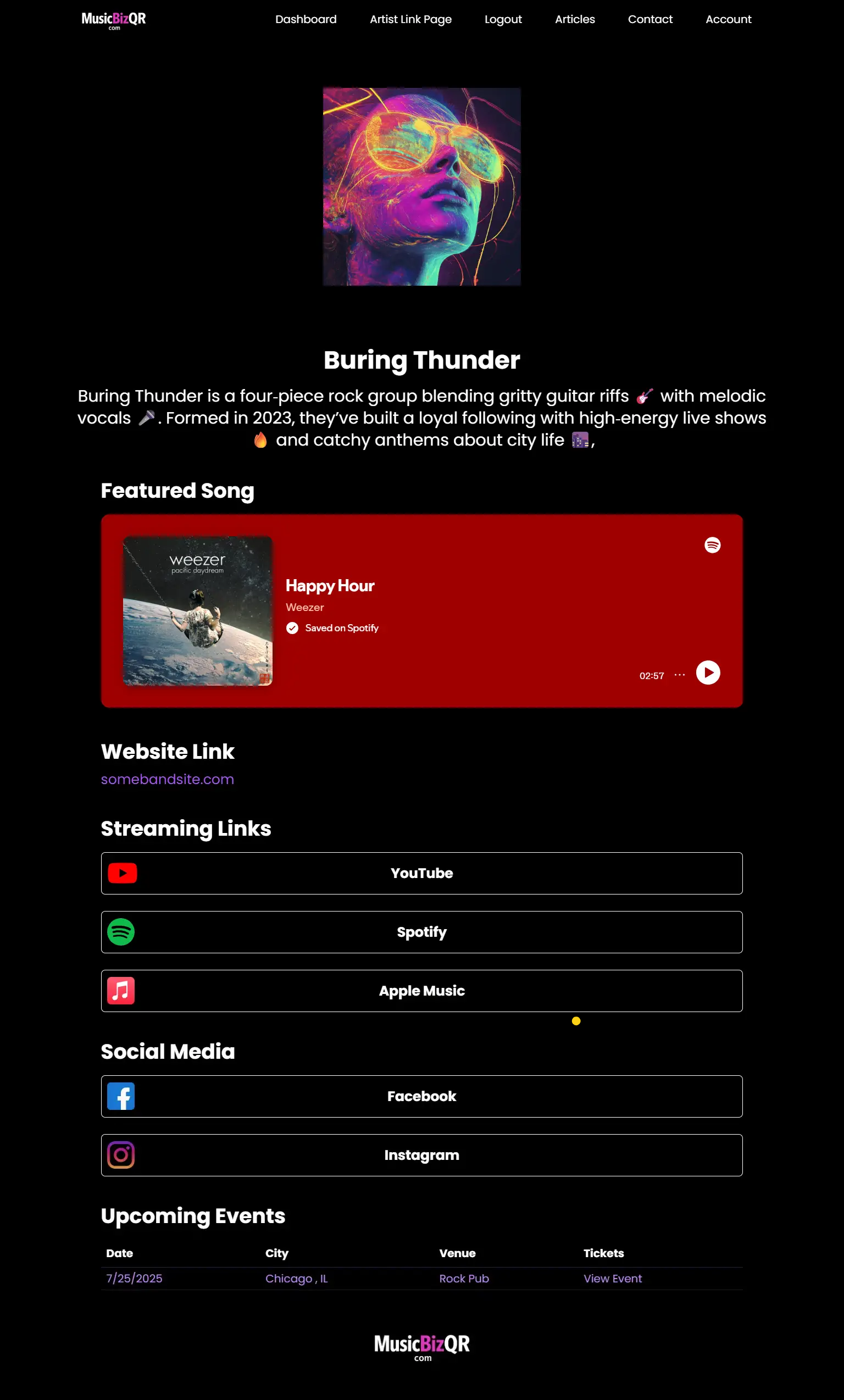
MusicBizQR gives you a powerful landing page with streaming links, videos, social buttons, and real-time fan analytics — all from a single QR code.
- 🎯 Unlimited link clicks & analytics
- 📈 Track Spotify streams, YouTube plays, and QR scans
- 📱 Mobile-optimized artist pages
- 🚀 Create your first Smart Link in seconds
Related Posts
Most link-in-bio tools weren’t built for musicians. Discover why smart links create better fan journeys, stronger branding, and higher conversions for your music.
Smart links for musicians explained—how they work, why they matter in 2026, and how to build a fan-converting link that drives your music career.
Discover how music links can help artists guide fans across platforms effortlessly. Learn strategies to boost engagement, streams, and merch sales.
Most link-in-bio tools weren’t designed for musicians. Learn why smart links deliver better fan engagement, stronger branding, and real music-driven revenue.
Smart links aren’t just utility tools — they’re the new frontier in artist branding. Learn how visual design, consistency, and fan-centric smart links define a musician’s digital identity.
Discover how smart links can transform fleeting music streams into lasting fan connections. Learn the strategies indie artists use to grow their audience in the streaming era.
Discover how smart links empower indie artists to create deeper, lasting relationships with fans. Turn every click into meaningful engagement.
Discover 2026’s best smart link tools for artists. We compare top platforms, fan engagement features, and why MusicBizQR stands above the rest.
Learn how direct-to-fan video turns your smart link into a conversion machine. Build trust, drive streams, and make real fan connections with MusicBizQR.
Learn how to use music links to drive fan engagement, increase streams, and promote your music like a pro. Built for modern artists and bands. Shall I begin writing the Markdown content for this article now?
In 2026, discovery is chaotic — and smart links are how artists bring it all together. Explore how music smart links guide fans, boost streams, and create real momentum across every platform.
Tired of generic link tools? Discover the smart link platform built for music: video previews, analytics, and full artist control—all in one sleek page.
Every new release deserves more than a link in your bio. Learn how to use smart links to drive streams, collect fans, and turn a single drop into lasting momentum.
The layout of your smart link page can make or break your fan engagement. Learn the design psychology that turns clicks into superfans.
If you're still sending fans to scattered links, you're leaving money on the table. Here's why every indie artist needs a smart link strategy to grow, connect, and convert.",
Most smart links just sit there. This guide shows musicians how to build a smart link page that turns casual clicks into lifelong fans. Real strategies that work.
Discover the psychology behind smart link layout design and how it shapes fan engagement, conversions, and merch sales.
Master the art of launching music with smart links. This guide shows how to create hype, drive streams, and maximize impact every time you drop a new release.
Your smart link is your new homepage. Learn how to design a 2026-ready page that plays your music instantly, tells your story, and converts fans the moment they land.
Learn how musicians can use smart links to connect directly with fans, bypass algorithms, and drive engagement, streams, and merch sales.
Discover how embedded content like music, videos, and social posts can turn your smart link into a fan engagement engine. Boost streams, merch sales, and loyalty.
Discover why smart links are transforming music marketing in 2025. Learn how a centralized hub can grow your audience, boost streams, and drive real fan engagement.
From Spotify embeds to merch and tour links, MusicBizQR makes music promotion easy. Learn how to use smart links to streamline your entire fan funnel.
Learn five powerful ways smart links can revolutionize your band's music promotion, amplify fan engagement, and strengthen fan loyalty.
Discover how smart links are revolutionizing music promotion, increasing fan engagement, boosting streaming numbers, and enhancing concert attendance.